
A few years ago, the idea of building a fast-growing business without employees sounded unrealistic. Growth was often tied to hiring, raising capital, and expanding operations. Entrepreneurs were expected to build teams before they could build momentum. Today, that assumption is changing.
Modern founders are proving that growth does not always require a larger workforce. With automation tools, digital products, and artificial intelligence becoming more accessible, many entrepreneurs are scaling revenue while keeping their businesses lean.
The rise of one-person business models has created a new path for founders who want speed, flexibility, and profitability without the complexity of managing a traditional company.
Why One-Person Business Models Are Gaining Momentum

The biggest advantage of a one-person business is simplicity. Every decision moves through a single person, which dramatically reduces delays. There are no lengthy approval chains, internal meetings, or communication gaps slowing progress.
At the same time, technology has removed many of the barriers that once made solo entrepreneurship difficult. Tasks that previously required separate marketing, sales, customer service, and operations teams can now be managed through software and automated workflows.
This shift has made the solopreneur business model attractive to experienced entrepreneurs and first-time founders alike. Instead of focusing on headcount, they focus on leverage. The goal is not to do more work but to create systems that produce more results.
How Entrepreneurs Are Growing Faster Without Large Teams
Traditional businesses often grow by adding employees. While that can increase capacity, it also introduces management responsibilities, payroll costs, and operational complexity.
Entrepreneurs using one-person business models take a different approach. They scale their digital infrastructure instead of their workforce.
This shift also connects closely with future of business operations, where modern companies are rethinking how technology, automation, and smarter systems shape everyday business growth.
Artificial intelligence has become one of the most important growth accelerators. Solo entrepreneurs use AI tools for content creation, product descriptions, market research, customer communication, and even software development support. Tasks that once consumed hours can now be completed in minutes.
Artificial intelligence has become one of the most important growth accelerators.
Another major advantage is automation. Founders build standard operating procedures and connect software platforms to automate repetitive work. Lead capture, email marketing, invoicing, onboarding, and follow-up sequences can often run with minimal manual involvement.
Without office leases or large salary commitments, many solo founders maintain extremely low overhead. This creates more flexibility to reinvest revenue into customer acquisition, product development, or audience growth.
The Growth Advantages That Set Solo Businesses Apart

One-person businesses often outperform larger organizations in several areas.
- Faster product launches and market testing
- Lower operating expenses
- Greater ability to pivot quickly
- Simplified decision-making
- Higher profit margins through automation
When market conditions change, solo entrepreneurs can adjust almost immediately. They do not need to coordinate multiple departments or secure approval from layers of management. This agility allows them to capitalize on opportunities that larger organizations may miss.
Business Models That Scale Well for Solo Founders
Not every business model is suited for a solo operator. The most successful entrepreneurs focus on models that create leverage and recurring value.
The most successful entrepreneurs focus on models that create leverage, recurring value, and low-maintenance growth. For founders researching scalable digital ideas, fastest growing online business models is a useful resource to understand which online models are gaining momentum before choosing a direction.
Productized Services
Instead of charging by the hour, many founders package their expertise into fixed-scope services with clear deliverables. This improves efficiency and creates a more predictable customer experience.
Digital Products
E-books, templates, memberships, and downloadable resources allow entrepreneurs to sell the same product repeatedly without increasing workload.
Online Courses
Knowledge-based businesses continue to thrive because educational content can serve thousands of customers without requiring one-on-one involvement.
Micro SaaS Businesses
Small software products that solve specific problems have become a popular, scalable business model. Many solo founders now use AI-assisted development tools to launch products much faster than before.
Content-Driven Businesses
Creators build audiences through newsletters, podcasts, YouTube channels, and social media platforms. These audiences become valuable distribution channels for products and services.
The Power of Personal Distribution

One trend that appears repeatedly among successful solo entrepreneurs is audience ownership.
Rather than spending heavily on advertising, they invest time in building a personal brand. Consistent content creation helps establish trust and attract potential customers organically.
A strong audience becomes a long-term business asset. New products, services, and offers can be introduced directly to an engaged community without depending entirely on paid traffic.
This approach also aligns naturally with founder productivity tips, as audience-building efforts often generate value long after the initial content is published.
Using Contractors Without Building a Team
One-person businesses do not necessarily mean doing everything alone.
Many entrepreneurs rely on specialized freelancers when needed. Instead of hiring full-time employees, they bring in experts for specific projects such as graphic design, video editing, legal work, or software development.
This plug-and-play approach keeps fixed costs low while providing access to specialized skills. It also allows founders to maintain flexibility as business needs change.
A Practical Roadmap for Scaling a One-Person Business
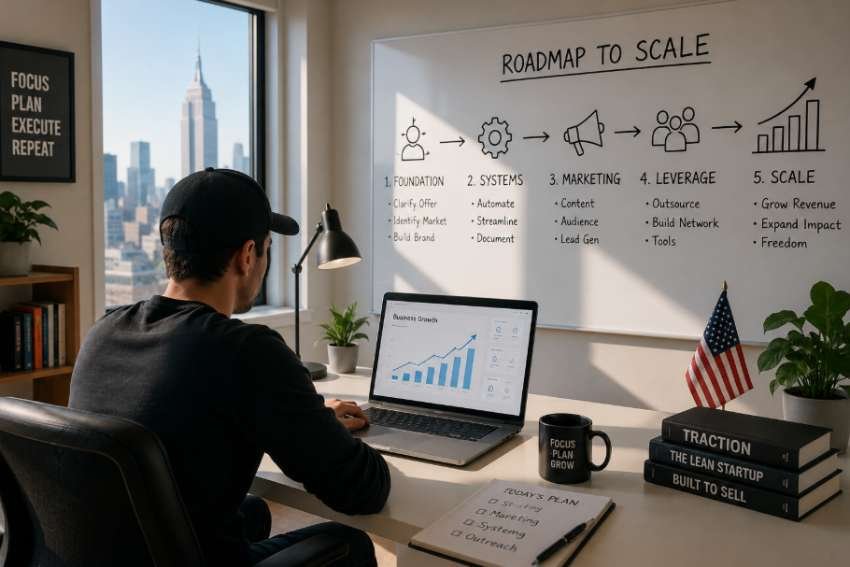
The most successful solo entrepreneurs typically follow a simple sequence.
First, they identify a specific problem for a clearly defined audience. Narrow positioning often produces better results than trying to serve everyone.
Second, they establish a recognizable brand narrative. People tend to connect with authentic individuals more easily than faceless organizations.
Third, they focus on perfecting one profitable offer. Many founders fail because they introduce too many products before validating demand.
Finally, they automate as much of the backend as possible. Customer relationship management systems, email automation, scheduling tools, and workflow platforms help create operational efficiency without adding staff.
FAQs
1. What are one-person business models?
One-person business models are businesses designed to operate primarily by a single founder using automation, technology, contractors, and scalable systems rather than a full-time team.
2. Can a one-person business become highly profitable?
Yes. Many solo entrepreneurs generate substantial revenue through digital products, consulting, software products, subscriptions, and content-driven businesses while maintaining low operating costs.
3. What is the biggest advantage of a one-person business?
The biggest advantage is agility. Solo founders can make decisions quickly, test ideas faster, and adapt to market changes without organizational delays.
4. Do one-person businesses eventually need employees?
Not always. Some entrepreneurs intentionally remain solo by using automation tools, outsourced specialists, and scalable digital assets to support growth without hiring permanent staff.
Final Thoughts
The rise of one-person business models reflects a fundamental shift in entrepreneurship. Growth is no longer tied exclusively to headcount, office space, or outside investment.
Today’s entrepreneurs are leveraging AI tools, automation, digital products, and personal brands to create businesses that move faster and operate more efficiently.
Instead of building large organizations, many founders are building systems that generate leverage. The result is a leaner, more adaptable approach to business growth that aligns with how modern markets operate.
For entrepreneurs willing to focus on efficiency, positioning, and automation, a one-person business can be far more scalable than many people realize.